
From the First wx+b to Here: Closing the Course
Twenty posts ago, this playlist's first lab was just this: f(x) = wx + b, the simplest model there is. I've now finished the specialization's first course, Supervised Machine Learning: Regression and Classification, and before moving on, it's worth stopping to look back: what actually held up out of all of it?
The thread running through the whole playlist
If there's one thing I didn't expect going in, it's how little genuinely new stuff I had to learn past the halfway point. Look at the pattern:
- Gradient descent showed up first for linear regression, and when it came back for classification, the loop was byte for byte the same. Only the math inside the derivative changed, because
fswapped from a line to a sigmoid. - Polynomial features, the trick of treating
x²,x³as if they were brand new variables, showed up in regression and came back, with the exact same core idea, in classification, just curving a decision boundary instead of a fitted curve. - Overfitting and regularization aren't exclusive to one kind of problem either: the same memorizing that ruins a regression curve ruins a classification boundary the same way, and the same
+ (lambda/2m) * sum(w²)penalty fixes both. - Scikit-learn was waiting in the background the whole time. Every time I finished building something by hand, the next lab showed the same thing in three lines, for regression and for classification, always with that one extra detail (regularization by default) that only made sense once I'd already felt its absence.
That changes how I think about the whole course: it wasn't "regression" and "classification" as two separate subjects, it was a small toolkit (gradient descent, feature mapping, regularization) that I watched work on two different problems. Learning the tool once paid off twice.
What I'm taking from this course
Single-variable linear regression looks like a toy it's so simple, but that's where all the machinery that carried the rest of the course showed up: cost function, partial derivative, learning rate, convergence. By the time classification arrived in Week 3, the only genuinely new piece was the sigmoid squashing the output between 0 and 1, everything else was the same machinery running underneath. And the course ends exactly where I least expected: overfitting isn't a bug, it's the price of giving a model too much flexibility, and regularization isn't magic, it's just a way of saying "trust the data, but not too much".
The certificate
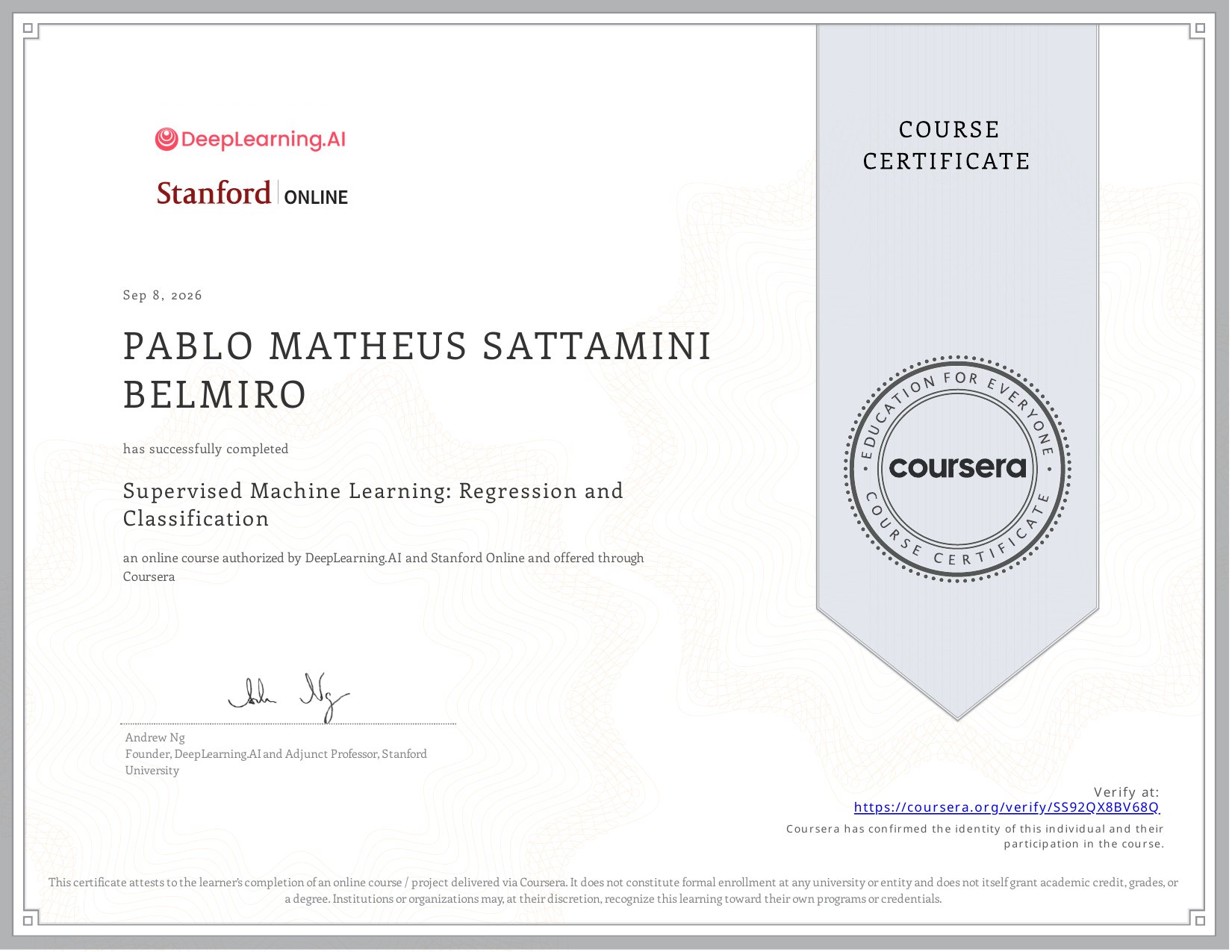
Download the PDF · Verify on Coursera
What's next
This playlist closes here for now, but Andrew Ng's specialization keeps going (Neural Networks and Decision Trees come in the next course, Unsupervised Learning and Recommender Systems in the third). If I keep studying, there'll be new posts. Until then, thanks for following along, from the line that wasn't enough to classify breast cancer all the way to the regularized boundary that closed the course.