Timeline
2026-08-28
Vim, Coursera, and a homemade Grafana setup
 1 / 4
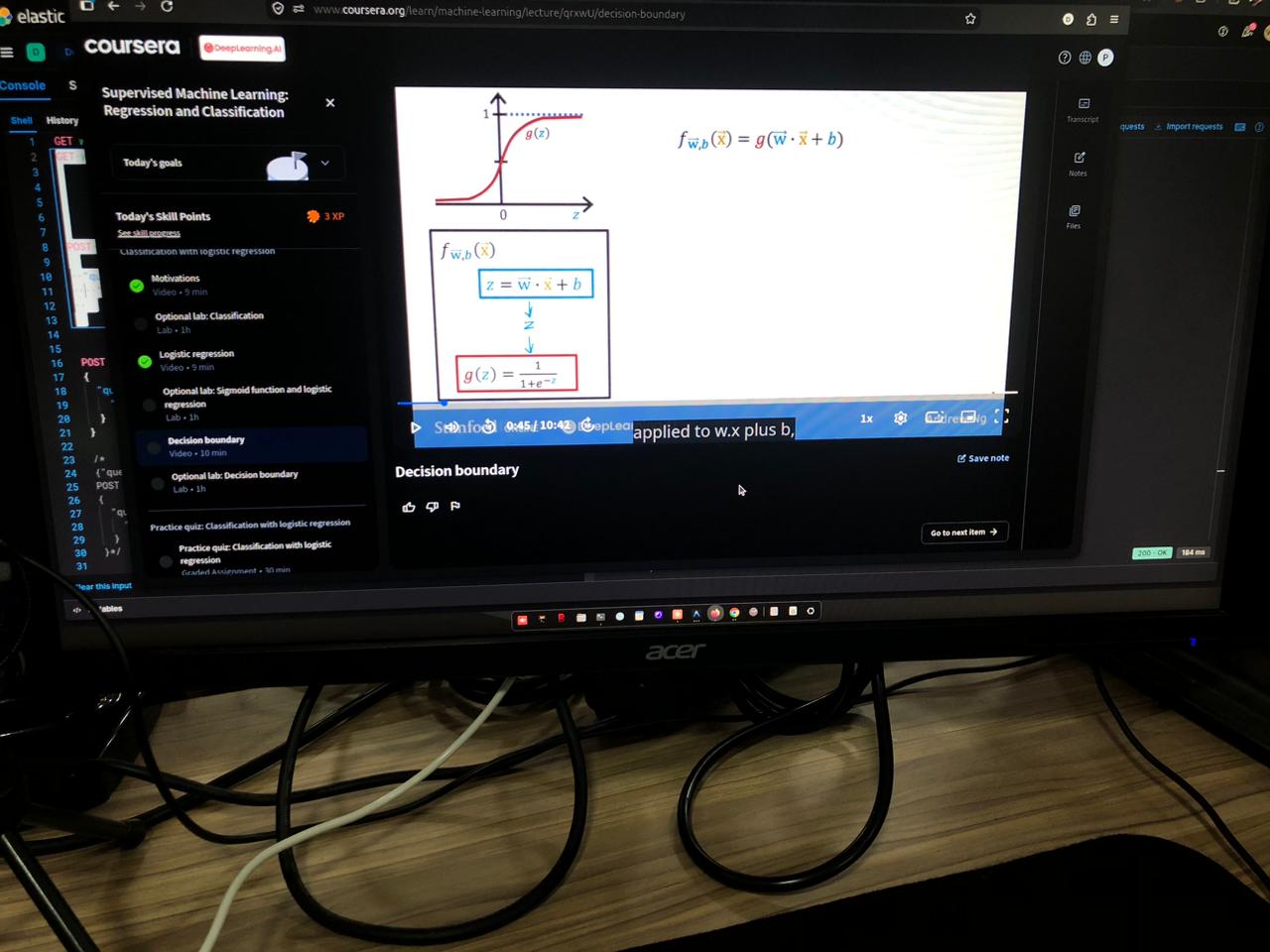
1 / 4Photo 1: I'm back on Andrew Ng's Machine Learning Specialization on Coursera, this time on the logistic regression module. I was watching the decision boundary lecture, the sigmoid function g(z) = 1/(1+e^-z) applied on top of w·x + b. This is raw material for the next posts in the Machine Learning Specialization playlist here on the blog, so I'm going through it carefully before bringing it over.
Photo 2: I got sick of being stuck in "modern" IDEs this week and went back to LazyVim (Neovim with a ready-made config on top). Left monitor with a project's PHP/Laravel code straight in the terminal, right monitor with a Claude Code session running alongside it. I miss the mouse sometimes, but the speed gain editing text makes up for it.
Photos 3 and 4: I put together a homemade monitoring setup for the VPSes I manage. Each server only has SSH and MySQL/Postgres running, nothing else installed on it. On my local machine, autossh keeps a tunnel permanently open to each server's database port, and a collector.py script per server logs in over SSH (through a multiplexed connection, so it doesn't open a fresh session every time) every so often to run a top and check whether the tunnel's port responds, saving CPU, memory, load, and availability into that server's own SQLite file. Grafana runs permanently, in Docker with network_mode: host so it can see the tunnels on loopback, reads those SQLite files for the historical system dashboards (photo 3), and also has a native database datasource per server, pointing straight at the tunnel, used for the "live" dashboards like MySQL's processlist or Postgres's pg_stat_activity (photo 4). Database metrics never go through the collector, Grafana itself queries them directly through the tunnel.
2026-08-25
From Boldt's whiteboard to a visit from Chongqing
 1 / 3
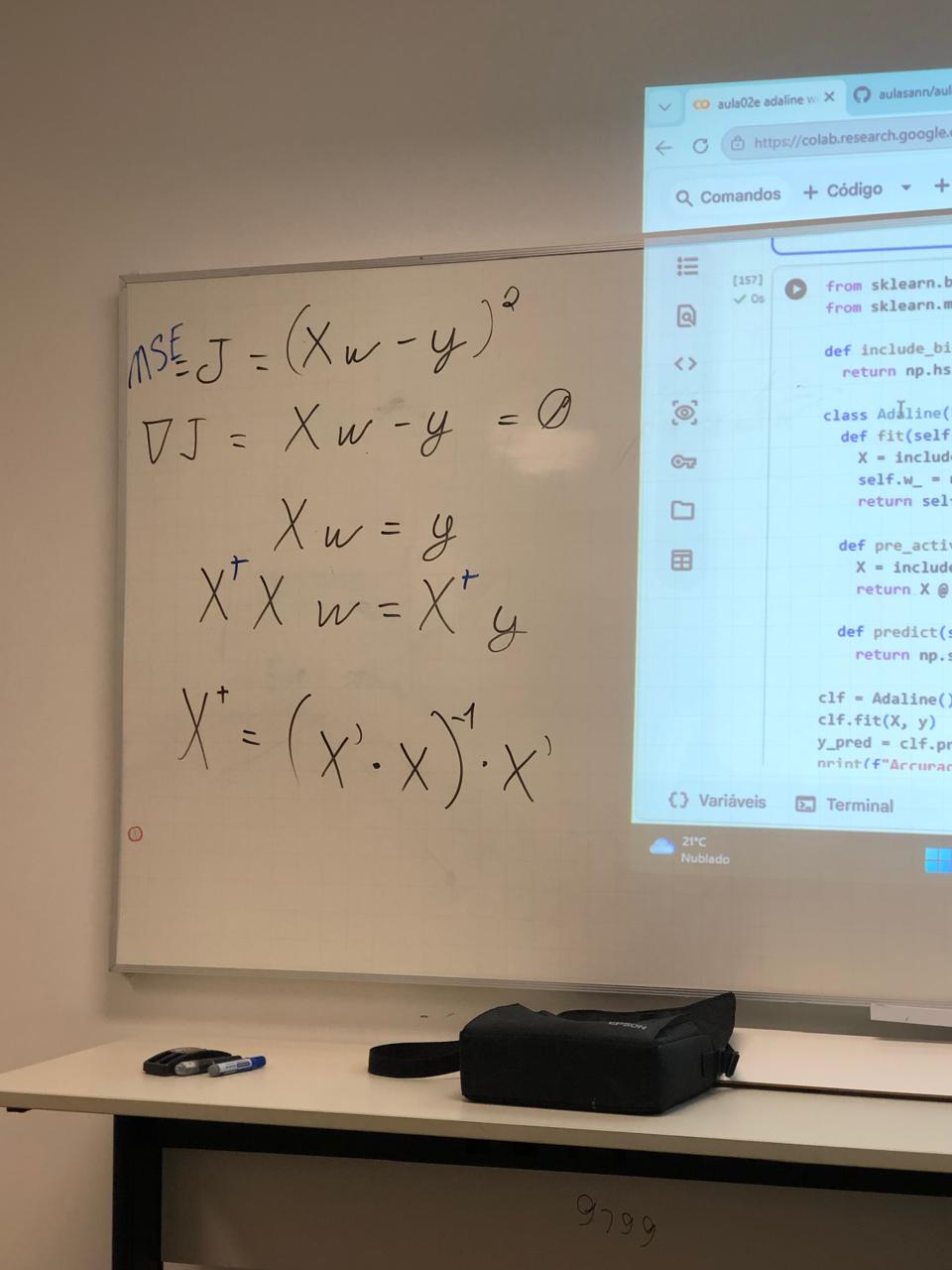
1 / 3Busy week here. The first two photos are from Boldt's Neural Networks class, the course I'm planning to turn into a new playlist on this blog once there's enough material to make posts out of. In the first one he was deriving ADALINE's normal equation on the whiteboard: start from the mean squared error (MSE) cost, zero out the gradient, and land on a closed-form solution via the pseudo-inverse instead of iterating with gradient descent. Nice to see the "pure" math before it turns into code.
In the second I caught a live bug: Boldt himself trying to plot the perceptron's decision hyperplane and hitting an AttributeError in front of everyone. Good to know even professors get bitten by matplotlib sometimes. Down in the corner you can see my tablet open on the original notebook from his GitHub repo, following along line by line.
The third photo is from a different day: IFES hosted a delegation from two Chinese universities, Chongqing University and Chongqing Technology and Business University, for a talk about research partnership between the institutions. Packed room, simultaneous translation, that whole "small world" feeling.
2026-08-19
Getting shaken up by Go
 1 / 4
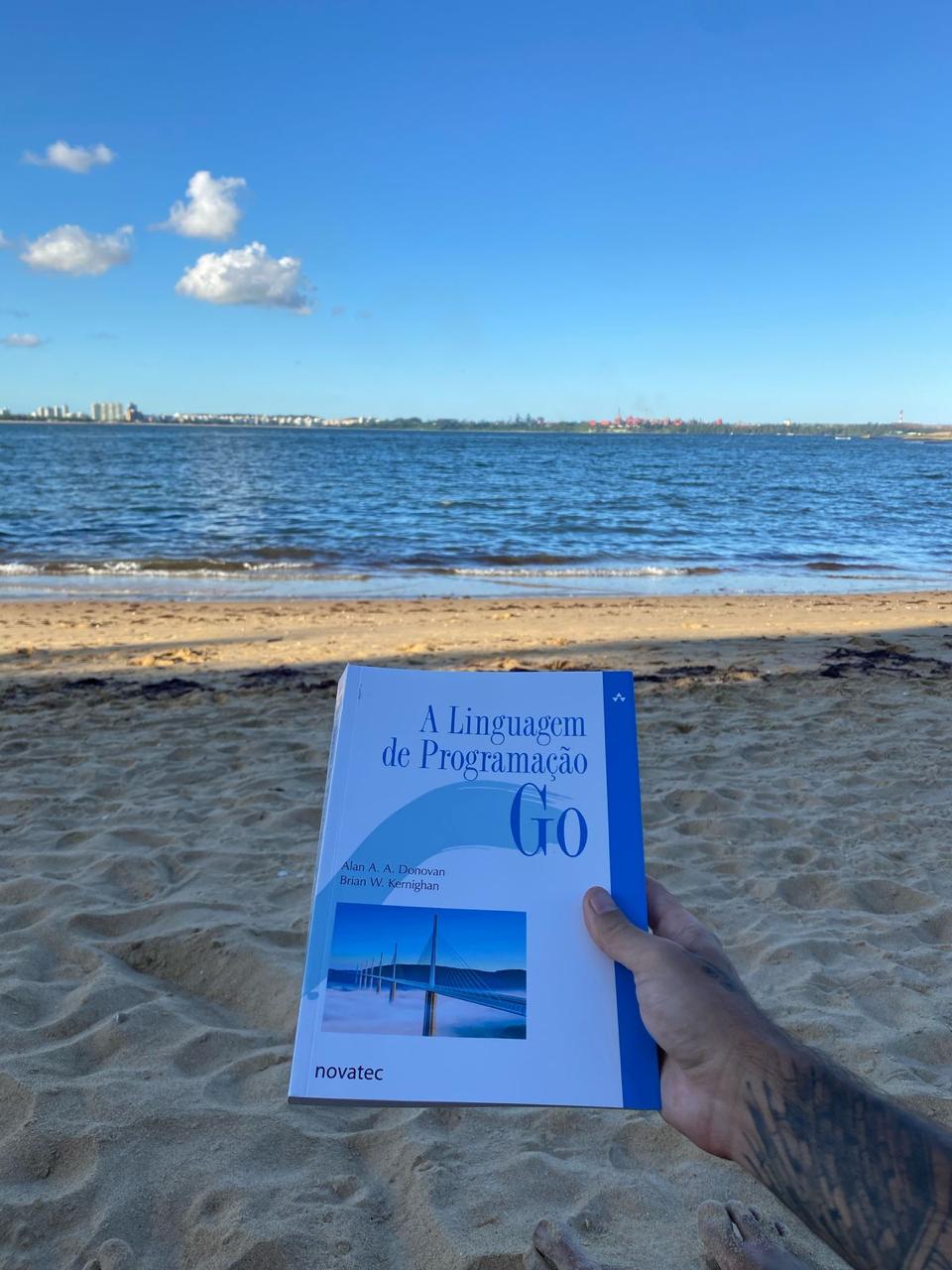
1 / 4I've been studying a lot of Go these past few weeks, and I mean that literally: I brought The Go Programming Language (the classic Donovan and Kernighan book, Brazilian edition) to the beach. Between waves, I got through a fair amount of it.
I'm getting a real shake-up trying to adapt to the "way of Go". After years used to Python, my brain has to relearn a much more explicit way of thinking: errors handled by hand instead of exceptions, static typing, concurrency that's part of the language itself instead of a framework bolted on top. Nothing absurd, just a different way of solving the same problem.
And the enthusiasm is real. I'm feeling a strong pull to gradually migrate toward Golang, mainly for its robustness: the compiler catches a ton of silly mistakes before the code even runs, and the performance is on another level. Unfortunately the Machine Learning and AI ecosystem in Go is still pretty thin on mature libraries, so I can't switch everything over at once. But I think in the long run the language has real potential to become an important piece in that space, especially for serving models in production.
And yes, the cat decided to show up in one of the photos too. He doesn't study Go with me, he just supervises.
2026-08-18
Chapter 2 of the SLM book, but with Dom Casmurro
 1 / 3
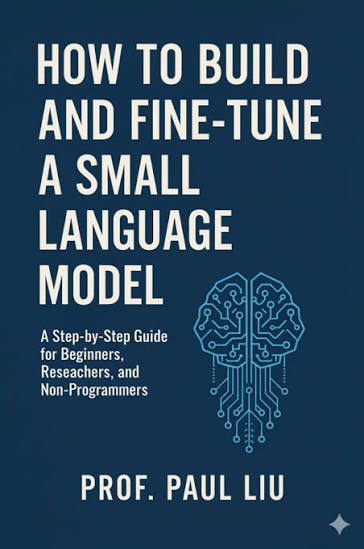
1 / 3Started Chapter 2 of How to Build and Fine-Tune a Small Language Model, by Prof. Paul Liu, and this time the exercise is building a small GPT from scratch, along the lines of Karpathy's "build a GPT", around 10 million parameters.
Instead of using the book's own example dataset though, I swapped it for a text I genuinely love: Dom Casmurro, by Machado de Assis. Same code, same architecture, but now tokenizing and training on Bentinho and Capitu instead of some generic corpus.
More updates coming soon once I wrap up this study.